
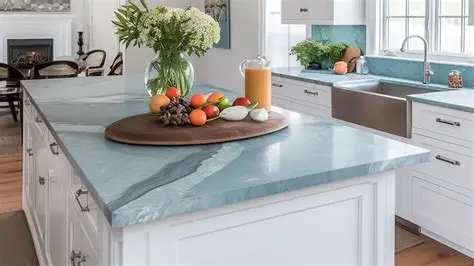
If you’ve had your granite countertops for a few years, you might be noticing the signs of real life:
- Dull, cloudy patches where it used to shine
- A few tiny chips along the edge
- Water spots, soap film, or stubborn marks that don’t seem to budge
And then the big question hits:
Can granite countertops be refinished, or do I have to replace them?
Short answer: yes, granite countertops can be refinished—and in most kitchens, they absolutely should be refinished long before you even think about replacing them.
The “basalt, granite, lucite, shale” bit you sometimes see in quizzes is just a reminder that we’re dealing with real igneous rock here—granite, not plastic (lucite) or sedimentary rock (shale). Its geological strength is exactly why refinishing is possible.
In this guide, we’ll cover:
- What refinishing granite actually means
- When you should (and shouldn’t) refinish
- Step-by-step refinishing basics
- How granite compares to other countertop materials
- How Aardwolf granite products fit into a longer-term plan for your kitchen
Granite Stone 101: Why It’s Refinishable
Before we talk about refinishing granite countertops, it helps to understand what granite actually is.
Granite geology and composition
Granite is a natural igneous rock formed from slowly cooled magma. Its granite geology and composition typically includes:
- Quartz – adds hardness and scratch resistance
- Feldspar – provides much of the white, cream, or pink background
- Mica & accessory minerals – add dark flecks, veins, and shimmer
These minerals give us the core characteristics of granite:
- Very high hardness and durability
- Excellent heat resistance
- Slight natural porosity
- Ability to take a high, mirror-like polish
That last point is the key: because granite can be honed and polished, you can refinish it—just like a stone floor or marble slab.

What Does “Refinishing Granite Countertops” Actually Mean?
Refinishing granite isn’t just one task—it’s usually a combination of:
- Deep cleaning to restore clean granite countertops
- Removing stains from granite (if needed)
- Repairing chips in granite
- Polishing granite surfaces to bring back the shine
- Sealing granite to protect the refreshed surface
Sometimes you only need a lighter refresh (clean, polish, seal). In more worn kitchens, a full restoration is better.
For a more restoration-focused walkthrough, you can also read:
Signs Your Granite Countertops Need Refinishing
You probably don’t need new counters—just refinishing—if you notice:
- Dullness or haze – the once-glossy surface looks flat or “chalky” in spots
- Micro-scratches – especially in busy prep areas
- Hard water and soap film – cloudy rings around faucets or sinks
- Tiny chips – along the edges or corners
- Stains or darkened areas – from coffee, oil, sauces, etc.
These are surface-level issues. The underlying granite stone is still incredibly strong.
Step 1: Clean Granite Countertops Like a Pro
Refinishing always starts with a proper deep clean. You can’t polish or seal over grease, film, or soap scum.
How to deep clean granite safely
- Clear the surface
Move appliances, decor, and anything else off the counter. - Dry dust
Use a soft microfiber cloth to remove crumbs and grit without scratching. - Wash with pH-neutral cleaner
- Warm water + a few drops of mild dish soap, or
- A cleaner specifically labeled safe for granite / natural stone.
- Rinse thoroughly
Wipe again with clean water to remove soap residue. - Dry completely
Use a clean, dry microfiber cloth. This shows you where dullness, staining, or etching actually exist.
If you see stubborn film (especially in bathrooms or around sinks), you may be dealing with soap buildup. For that, use:
Once everything is squeaky clean, you’ll have a clear picture of what refinishing is needed.
Step 2: Removing Stains From Granite Before Refinishing
You don’t want to polish over stains. Deal with these first.
Common granite stains
- Coffee, tea, wine – usually brownish or reddish marks
- Oil and grease – dark, shadowy spots that don’t evaporate
- Ink and permanent marker (Sharpie) – colored lines or scribbles
- Soap scum and mineral deposits – cloudy patches near sinks
Stain removal depends on the cause. These resources are extremely helpful:
- Superglue on granite:
If you’ve had craft accidents or glue drips, see
How to remove superglue from granite - Permanent marker / Sharpie stains:
For kids’ art or accidental markings, use
How to get Sharpie off granite - Soap film and hard water:
Again, refer to
How to remove soap scum from granite
Deeper stains may require a poultice to draw contaminants out of the stone. Once stains are reduced or removed, your later polishing and sealing will look much more even and professional.
Step 3: Repairing Chips in Granite Before You Polish
Next, address any physical damage. Even though granite is very hard, edges and corners can chip.
DIY chip repair
Small chips are often fixable at home:
- Clean and dry the chipped area thoroughly.
- Use a clear or color-matched epoxy made for stone.
- Fill the chip carefully until it’s level with the surrounding surface.
- Allow the epoxy to cure fully.
- If the kit instructions allow, lightly smooth any high spots and buff.
When to call a pro
Consider professional help if:
- Chips are large, deep, or clustered
- Cracks run into seams or across corners
- The granite stone feels unstable or poorly supported
A stone restoration pro can blend repairs and re-polish so they’re almost invisible.
Step 4: Polishing Granite Surfaces to Bring Back the Shine
Now we reach the most satisfying part of refinishing granite countertops: making them shine again.
Light DIY polishing
For counters that are just a bit dull:
- Use a granite-specific polish or cream (avoid furniture polish and wax).
- Apply a thin, even coat as directed by the product.
- Buff with a clean microfiber cloth in small, overlapping circles.
This works well for both a white granite countertop (which can look “chalky” when dull) and black granite countertops (which lose depth and mirror reflection when the polish is worn).
Professional honing and polishing
For more serious wear:
- Widespread etching from harsh cleaners
- Numerous fine scratches
- Uneven finish (some areas shiny, others flat)
…you might want professional honing and polishing. Specialists use diamond abrasives and water to gently remove a thin layer of stone, then gradually refine it to a high gloss.
For a more complete restoration workflow, you can also reference:
Step 5: Sealing Granite to Protect Your Refinished Countertops
This is the step people skip most often—and regret later.
Why sealing granite matters
Because of its crystalline structure, granite is slightly porous, not perfectly non-porous. Liquids like oil, wine, and deeply colored sauces can seep into microscopic pores if the stone isn’t sealed.
Sealing granite:
- Reduces absorption
- Makes spills easier to wipe up
- Helps prevent stains and long-term dullness
How to seal granite countertops
- Test for absorption
Drip a small amount of water on the counter. If it darkens within a few minutes, it’s time to reseal. - Clean and dry
Make sure the surface is spotless and completely dry. - Apply a penetrating sealer
Use a clean cloth or applicator across small sections. - Let it dwell
Allow the sealer to soak in for the recommended time. - Wipe and buff
Remove any excess with a clean, dry cloth. Buff until the surface feels smooth and residue-free. - Allow to cure
Avoid heavy use or getting the surface wet until cure time is complete (check the label).
Once sealed, your refinished granite will stay attractive and easier to maintain.
Natural vs. Engineered Granite: Can Both Be Refinished?
Refinishing works beautifully on natural granite stone. For natural vs. engineered granite (quartz) surfaces:
- Natural granite
- Can be cleaned, repaired, polished, and resealed many times
- Each slab is unique, with natural veining and color variation
- Engineered quartz
- Non-porous and doesn’t need sealing
- Damage can be harder to “refinish”; deep burns or cracks may require replacement or professional repair
So when you ask “can granite countertops be refinished?”, the answer is a strong yes for natural granite and a cautious it depends for quartz or other engineered materials.
Granite vs Other Materials: Is Refinishing Worth It?
A quick natural stone countertop comparison helps put things in context:
- Granite vs quartz countertops
- Granite: refinishable, heat-resistant, needs sealing
- Quartz: low-maintenance, non-porous, but less heat-tolerant
- Granite vs marble: pros and cons
- Marble: softer, more prone to etching and staining, trickier to refinish
- Granite: harder, more forgiving, easier to maintain a polished finish
- Granite vs soapstone durability
- Soapstone: very stain-resistant but softer and easier to scratch
- Granite: more scratch-resistant and better at holding a shine with refinishing
- Granite better than concrete countertops?
- Concrete: can crack, highly porous, heavily dependent on sealers
- Granite: naturally strong and durable, making refinishing more effective and longer-lasting
For many homeowners, refinishing granite countertops is far more cost-effective than replacing them—or replacing them with something that doesn’t perform as well.
Granite Countertop Cost, Sourcing & Aardwolf Solutions
Granite countertop cost and where to buy
If refinishing inspires you to extend or update your surfaces, understanding granite countertop cost and sourcing helps:
- Prices vary by rarity, color, and veining
- Local fabricators, stone yards, and wholesale granite suppliers offer a range of options
- Big-box retailers often provide affordable granite countertop options in more common patterns
Aardwolf granite: premium slabs and professional installation
If you decide to mix refinishing with new installations:
- The Aardwolf granite countertop collection offers carefully selected stones designed for both beauty and performance.
- Aardwolf premium granite slabs are ideal if you want to add an island or replace a damaged section while keeping your existing stone.
- With Aardwolf granite installation services, you get expert templating, cutting, seam placement, and proper initial sealing.
- The Aardwolf granite pricing guide helps you choose among tiers and identify the best Aardwolf granite colors for your cabinets, flooring, and granite backsplash designs.
Combining refinishing with strategic upgrades can transform your kitchen or bath without the cost and chaos of a total gut renovation.
Final Answer: Can Granite Countertops Be Refinished?
Yes—granite countertops absolutely can be refinished, and in most cases they should be refinished long before you consider replacing them.
A solid refinishing plan includes:
- Deep cleaning to reveal the true condition
- Targeted stain removal using guides like those for superglue, Sharpie, and soap scum
- Repairing chips in granite for smooth, safe edges
- Polishing granite surfaces to restore shine and color depth
- Sealing granite to protect your work and keep your counters looking new