

If your granite countertops have lost their shine, picked up stains, or have a few small chips along the edges, you might be wondering:
Can I refinish granite countertops myself, or do I need to replace them?
The great news: yes, granite countertops can be refinished—and in most cases, refinishing is far cheaper (and less stressful) than tearing everything out and starting again.
Unlike softer rocks such as shale (which is far too weak and flaky for kitchen use), granite stone is a dense, durable igneous rock. That strength is exactly what makes it refinishable: you can deep clean it, repair minor damage, re-polish the surface, and seal it for many more years of use.
In this guide, you’ll learn:
- How granite’s geology and composition affect refinishing
- A step-by-step process to refinish granite countertops
- How to deal with superglue, Sharpie, and soap scum
- How granite compares to quartz, marble, soapstone, and concrete
- Where Aardwolf granite products fit into your long-term countertop plan
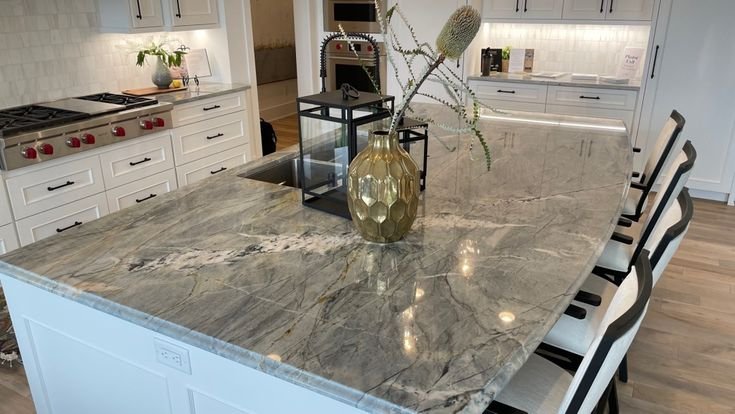
Understanding Granite Stone Before You Refinish
Granite geology and composition
Granite is an intrusive igneous rock, formed when magma cools slowly deep beneath the Earth’s surface. That slow cooling allows big, visible crystals to grow, typically:
- Quartz – adds hardness and scratch resistance
- Feldspar – provides much of the white, cream, or pink background
- Mica & accessory minerals – create dark flecks, veins, and sparkle
These minerals give granite the key characteristics of granite that matter in your kitchen:
- Very high hardness and durability
- Excellent heat resistance
- Slight natural porosity (important for sealing)
- Ability to take a high, mirror-like polish
That’s why granite—unlike shale or other soft rocks—can handle decades of use and still come back to life with a good refinishing.
Natural vs engineered granite (quartz)
When we talk about natural vs. engineered granite, we’re really talking about:
- Natural granite – actual stone quarried in blocks, cut into slabs, and polished
- Quartz (engineered stone) – crushed stone mixed with resins and pigments, then cast into slabs
This article focuses on refinishing natural granite countertops. Quartz can sometimes be resurfaced, but it’s a different process, and the resins limit how aggressively it can be honed or polished.
Can Granite Countertops Be Refinished?
Yes—granite countertops can absolutely be refinished. Refinishing usually means:
- Deep cleaning to restore clean granite countertops
- Removing stains from granite with targeted methods
- Repairing chips in granite and small cracks
- Polishing granite surfaces to restore shine
- Sealing granite to protect against future stains and wear
You don’t always need every step, but this is the full “reset” process that takes granite from dull and tired back to rich and glossy.
Step 1: Inspect and Prep Your Granite Countertops
Before you start, take a slow walk around your countertops and check for:
- Dull or cloudy patches
- Chips along the edges or at corners
- Stains (oil, wine, coffee, marker, etc.)
- Etching or subtle surface roughness around sinks or cooktops
Clear everything off the counters—appliances, decor, dish racks—so you can reach every inch of stone.
This is also a good moment to think about your overall design:
- Do you want to highlight a white granite countertop with painted cabinets?
- Are you planning a bold black granite countertops look with light cabinetry?
When you refinish, you’re not just restoring function—you’re revealing the stone’s full design potential again.
Step 2: Deep Clean for Truly Clean Granite Countertops
You can’t refinish over grease, soap film, and hard water deposits. Start with a proper deep clean.
How to deep clean granite safely
- Dust and wipe
Use a dry microfiber cloth to remove crumbs and loose grit. - Wash with a pH-neutral cleaner
- Mix warm water with a few drops of mild dish soap, or
- Use a cleaner specifically labeled safe for granite/natural stone.
- Rinse thoroughly
Wipe again with clean water to remove soap residue. - Dry completely
Buff with a clean microfiber towel. Once dry, you’ll clearly see where stains or dull areas remain.
If you notice a persistent cloudy film, especially near sinks or in bathrooms, you’re likely dealing with soap scum or mineral buildup. For those areas, use this detailed guide:
After this step, you’re ready to tackle stains and damage.
Step 3: Removing Stains From Granite
Refinishing isn’t just about shine—it’s about evening out the color and removing blemishes.
Common granite stains include:
- Oil and grease – dark, shadowy areas that don’t evaporate
- Wine, coffee, and food – colored rings or spots
- Ink and permanent marker – Sharpie and pen marks
- Adhesives and superglue – from crafts or repairs
Targeted stain removal resources
Use the right method for the right stain:
- Superglue or adhesive on granite
Accidental drips happen. For step-by-step removal:
👉 How to remove superglue from granite - Sharpie and ink stains
Kids’ artwork or a stray marker line? Start here:
👉 How to get Sharpie off granite - Soap scum and residue
Revisit:
👉 How to remove soap scum from granite
For deeper stains, you may need a poultice—a paste applied to the stain that draws contaminants out of the stone. Removing stains now ensures your final polished surface looks uniform, not “glossy but still blotchy.”
Step 4: Repairing Chips in Granite Edges and Corners
Even though granite is extremely hard, edges and corners can chip when hit with heavy pots or dropped objects.
DIY chip repair
For small chips:
- Clean and dry the chipped area thoroughly.
- Use a clear or color-matched stone epoxy from a reputable kit.
- Carefully fill the chip so the epoxy is just slightly proud of the surface.
- Allow it to cure fully (according to product directions).
- If the kit allows, carefully level any excess with a razor or fine abrasive, then buff.
When to call a pro
You’ll want professional help if:
- Chips are large or extend into cracks
- Damage is near seams or undermount sinks
- The countertop feels unstable or poorly supported
Pros can blend repairs with honing and polishing so they’re nearly invisible.
Step 5: Polishing Granite Surfaces to Restore Shine
Now for the part that really makes refinishing feel worth it: restoring that deep, reflective shine.
Light polishing at home
If your granite is structurally sound and mostly just dull:
- Choose a granite-specific polish or polishing compound (avoid furniture waxes or generic polishes).
- Apply a thin, even layer to a small area.
- Buff with a clean microfiber cloth in systematic, overlapping circles.
This approach works especially well for:
- A tired-looking white granite countertop that has gone flat
- Black granite countertops that have lost depth and mirror-like reflection
Professional honing and polishing
If you have:
- Widespread etching or light surface scratches
- Very uneven gloss levels
- Heavy wear in high-traffic areas
…a stone restoration professional can hone (smooth) and polish the surface using diamond abrasives and water. This removes a very thin layer of stone and brings the finish back to a factory-like sheen.
For a more restoration-focused look at the overall process, pair this guide with:
👉 How to restore granite countertops
Step 6: Sealing Granite for Long-Term Protection
Once your granite is clean, repaired, and polished, sealing is non-negotiable if you want to keep it looking good.
Why sealing granite matters
Granite is very dense, but at a microscopic level it still has tiny pores between mineral grains. Liquids like oil, wine, and dark sauces can seep into these pores and leave stains if the stone isn’t sealed.
Sealing granite:
- Reduces absorption dramatically
- Makes spills easier to wipe up
- Protects the surface you just worked so hard to refinish
How to seal granite countertops
- Test whether you need sealer
Put a few drops of water on the stone. If it darkens within a few minutes, it’s time to reseal. - Clean and dry
Ensure the surface is spotless and fully dry. - Apply penetrating sealer
- Use a soft cloth, foam applicator, or sealer pad.
- Work in manageable sections and follow label directions.
- Allow to dwell
Let the sealer soak in for the recommended time. - Wipe and buff
Remove excess sealer with a clean cloth and buff until the surface feels smooth, not sticky. - Cure
Avoid standing water and heavy use until the sealer has fully cured.
Refinishing Granite vs Replacing: Granite Countertop Cost
Refinishing is almost always cheaper than replacing.
- Refinishing cost depends on whether you DIY or hire a pro, but it’s typically a fraction of full replacement.
- Granite countertop cost for replacement includes new material, fabrication, removal of the old tops, and installation.
If you still like your color and layout, refinishing gives you “new countertop energy” without the price tag of brand-new stone.
If you’re unhappy with your color or layout, then:
- Explore where to buy granite countertops locally
- Compare affordable granite countertop options vs more exotic stones
- Visit wholesale granite suppliers to see full slabs before you commit
Granite vs Other Countertop Materials During Refinishing
If you’re doing all this work, you might also wonder whether granite is still the best choice.
Granite vs quartz countertops
- Granite – natural, unique, heat-resistant, slightly porous (needs sealing), refinishable.
- Quartz – engineered, non-porous (no sealing), very consistent, less tolerant of high heat.
Granite vs marble: pros and cons
- Marble – beautiful but soft and very prone to etching.
- Granite – tougher, better for busy kitchens, easier to keep glossy after refinishing.
Granite vs soapstone durability
- Soapstone – very stain-resistant, but soft and prone to scratches.
- Granite – more scratch-resistant, great for maintaining a polished look over time.
Granite better than concrete countertops?
- Concrete – highly porous, can crack, and requires extensive sealing.
- Granite – naturally dense and strong, making it easier to live with and refinish over the years.
Across most natural stone countertop comparison scenarios, granite remains one of the best all-around performers—especially when you can refinish it instead of replacing it.
Design Payoff After Refinishing: Make Your Granite Pop
Once your stone is back to its glossy, refined best, you can lean into design:
- Choose paint and stain that complement your white granite countertop or black granite countertops.
- Refresh grout, fixtures, and hardware to match.
- Explore granite backsplash designs—from simple tile to dramatic full-slab backsplash.
- Spend time pairing granite with cabinet colors so undertones don’t clash (warm granite with warm cabinets, cool with cool, or intentional contrast).
How Aardwolf Fits Into Your Granite Plans
If refinishing inspires you to add an island, extend a countertop, or upgrade to a new layout, Aardwolf can help.
- The Aardwolf granite countertop collection features carefully selected stones ideal for both new installations and matching existing designs.
- Aardwolf premium granite slabs offer strength, consistent quality, and beautiful patterns to complement your refinished surfaces.
- With Aardwolf granite installation services, you get professional templating, cutting, edge profiling, and correct initial sealing.
- The Aardwolf granite pricing guide helps you understand cost tiers and choose from the best Aardwolf granite colors that work with your cabinets, floors, and backsplash.
Combining professional installation for new sections with smart refinishing on existing tops can give you a cohesive, high-end look without a full gut renovation.
Final Thoughts: Granite Is Built to Be Refinished
Unlike weak stones such as shale, granite stone is tough, dense, and designed—by nature—to last. That’s why refinishing granite countertops is not only possible but often the smartest way to refresh your kitchen or bath.
To recap:
- Deep clean the stone thoroughly.
- Use targeted methods to remove stains from granite (superglue, Sharpie, soap scum, etc.).
- Repair chips in granite edges and corners.
- Polish granite surfaces to restore their shine.
- Seal granite to protect your investment and simplify future cleaning.