
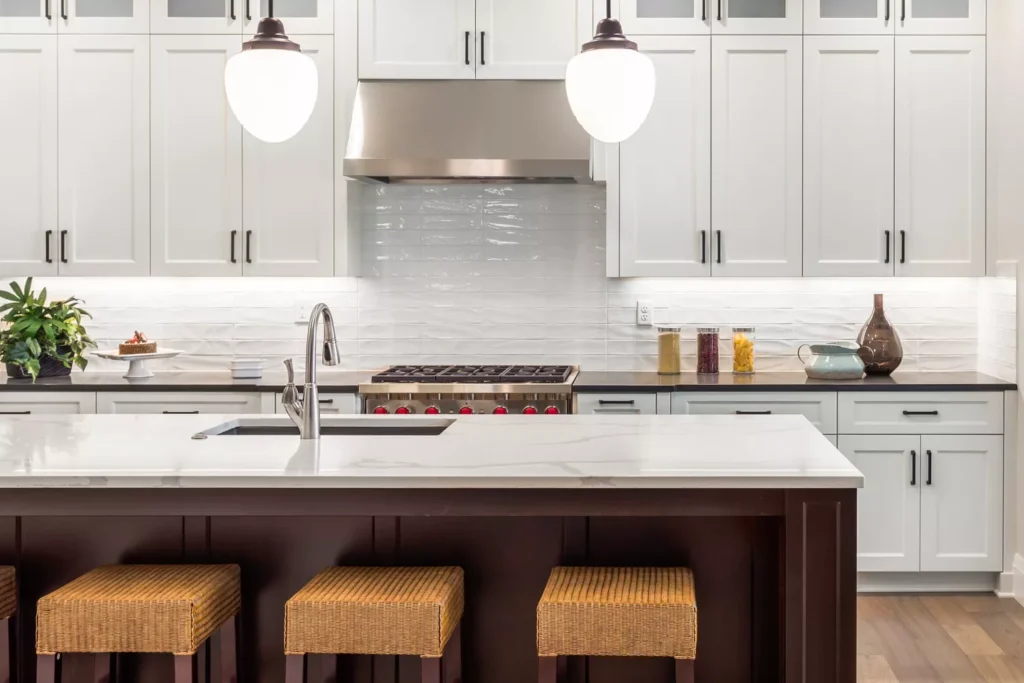
Discovering a chip in your granite countertop is a horrible feeling. Granite is known for strength, luxury, and long life so when a corner pops off or a little chunk disappears near the sink, it’s easy to panic and assume the whole top is ruined.
The reality is much kinder:
In most cases, you can fix a chip in granite so well that it’s hard to spot in daily use.
Unlike softer rocks like shale, which break and flake easily, granite stone is a dense, crystalline material that responds well to repair, polishing, and refinishing. With the right products and a careful process, repairing chips in granite is usually far cheaper than replacing the entire countertop.
In this guide, we’ll cover:
- What granite is (and why it behaves very differently from shale)
- What causes chips in granite countertops
- A step-by-step process for how to fix a chip in granite
- How sealing, cleaning, and polishing fit into long-term maintenance
- Where granite fits in a natural stone countertop comparison
- How Aardwolf’s granite collections, slabs, and services support both repair and replacement projects
You can dive deeper into related topics here:
- How to restore granite countertops
- How to refinish granite countertops
- Can Granite Countertops Be Refinished?
- How to repair chipped granite
Understanding Granite Stone: Geology, Durability & Why It Chips
Granite geology and composition
Granite is an intrusive igneous rock, formed when molten magma cools slowly deep beneath the Earth’s surface. This slow cooling builds large, interlocking crystals of:
- Quartz – extremely hard, adds scratch resistance
- Feldspar – controls much of the base color (white, grey, cream, pink)
- Mica & other minerals – add dark flecks, veins, and subtle sparkle
These minerals create the core characteristics of granite:
- High compressive strength and durability
- Excellent heat resistance (better than most engineered surfaces)
- Slight porosity (managed through sealing granite)
- A dense structure that can be polished and even refinished
Granite vs shale: why shale doesn’t belong in your kitchen
Shale is a soft, layered sedimentary rock made from compressed mud and clay. It:
- Splits into thin, fragile sheets
- Crumbles and weathers quickly
- Lacks the strength for counters, floors, or any heavy-use surface
In a natural stone countertop comparison, granite easily beats shale: granite is strong enough to use for counters, and strong enough to repair when the occasional chip happens.

Why Granite Countertops Chip: Edges, Impacts & Everyday Use
Even though granite is tough, it’s not invincible. Most chips happen in predictable places:
- Front edges – hit by heavy pots, pans, or dropped objects
- Sink cutouts – thinner stone around undermount sinks is more vulnerable
- Corners – outside corners take the brunt of impacts
- Dishwasher or range openings – during installation or appliance movement
These chips don’t mean the stone is “bad.” They usually reflect:
- A sharp impact on a small contact point
- Slightly under-supported overhangs
- Normal wear in a busy kitchen or bath
The good news is that granite vs quartz countertops both chip under hard impact—but granite’s natural structure makes it very repairable.
DIY or Pro? Deciding How to Fix a Chip in Granite
Before you start, take a close look at the damage:
- Small chips / pits
– Ideal for DIY epoxy repair. - Medium chips on edges
– Often still DIY-friendly if you’re patient and careful. - Large missing chunks / structural cracks
– Call a professional stone restoration specialist.
If the chip is deep, runs into a seam, or is near a sagging sink, professional inspection is smart. But for typical chips on an edge or near a sink, you can usually handle repairing chips in granite yourself.
Step-by-Step: How to Fix a Chip in Granite Countertops
Step 1: Gather your granite repair materials
To fix a chip in granite, you’ll usually need:
- Stone-safe cleaner or mild dish soap
- Clean water and microfiber cloths
- Isopropyl alcohol (for final degreasing)
- Painter’s tape (to protect surrounding granite stone)
- A clear or tinted epoxy or acrylic granite repair kit
- Mixing tray and sticks
- Small applicator (toothpick, craft stick, tiny spatula, or plastic blade)
- Razor blade (if your kit recommends trimming)
- Optional: small polishing pads or a polishing compound
For highly visible areas on a white granite countertop or black granite countertops, choose a kit with tints so you can better match the stone.
Step 2: Clean granite countertops thoroughly
Epoxy won’t bond to grease, soap film, or grime.
- Wash the area around the chip with warm water and mild dish soap or a stone-safe cleaner.
- Rinse with clean water and dry with a microfiber cloth.
- Degrease the chipped area with a light wipe of isopropyl alcohol. Let dry completely.
If you’re dealing with older tops that look cloudy or dull, consider a deeper clean and restoration approach:
Clean stone is the foundation for a successful repair and later sealing granite.
Step 3: Mask around the chip
Use painter’s tape to protect the surrounding polished granite surfaces:
- Tape just outside the chipped area, following the edge profile.
- Leave the chip itself exposed.
This step prevents epoxy from spreading onto the rest of your granite stone, which can create a lumpy or cloudy patch if not removed perfectly.
Step 4: Mix your granite chip repair epoxy
Follow the directions on your repair kit carefully:
- Dispense the recommended amounts of resin and hardener onto your mixing tray.
- Stir thoroughly until well blended.
- If tints are provided, add tiny amounts at a time to approximate your granite’s color.
You rarely need a perfect color match—granite’s specks and patterns help disguise minor differences, especially after light polishing granite surfaces.
Step 5: Fill the chip in the granite
This is the heart of how to fix a chip in granite.
- Apply the filler
- Use your applicator to push epoxy deep into the chip.
- Make sure you fill all voids; avoid trapping air bubbles.
- Slightly overfill
- Leave the epoxy just above the surrounding surface.
- It’s easier to trim down than to refill a low spot.
- Shape the repair
- While the epoxy is still workable, roughly mimic the natural edge or corner shape.
- Clean the tape
- Wipe excess epoxy off taped areas before it starts to cure.
- Let it cure completely
- Follow the cure time given in the kit—this may be several hours or overnight.
Once cured, the chip is structurally filled and ready for finishing.
Step 6: Level and polish the repaired granite
After the filler is fully hardened:
- Remove the painter’s tape carefully.
- Trim high spots
- If your kit recommends it, use a razor blade held nearly flat to gently shave off any raised epoxy. Always pull the blade across the filler, not into the stone.
- Blend and polish
- Use fine polishing pads or polishing compound to smooth the transition between the repair and the surrounding granite.
- Aim to match the existing sheen as closely as possible.
If your entire top is showing wear, scratches, or dullness, it may be time to refinish the surface:
Or, if you’re exploring the bigger picture:
- Can Granite Countertops Be Refinished?
The answer is yes—refinishing is one of granite’s big advantages over many materials.
Step 7: Seal granite after your chip repair
Once the surface looks smooth and consistent, refresh the sealer across the whole counter:
- Ensure the countertop is clean and dry.
- Apply a penetrating sealer evenly with a soft cloth or applicator.
- Allow the sealer to dwell for the time recommended on the label.
- Wipe off excess and buff with a clean cloth.
Proper sealing granite:
- Helps prevent stains
- Makes clean granite countertops easier to maintain
- Extends the life of your repair and the stone itself
Granite Countertop Cost: Why Repair Often Beats Replacement
A well-done chip repair is usually inexpensive compared to full replacement.
- DIY repair kits cost a fraction of a new slab.
- Professional repairs are still far cheaper than changing the entire countertop.
- Full replacement includes new stone, fabrication, installation, and often plumbing work.
That’s why, in many homes, small repairs + occasional refinishing give the best return on your original granite countertop cost.
If you ever do decide to replace or extend, you can start exploring:
- Where to buy granite countertops
- Affordable granite countertop options at big-box stores
- Wholesale granite suppliers for hand-picked slabs
How a Repaired Granite Countertop Compares to Other Materials
Granite vs quartz countertops
Both can chip, but their behavior differs:
- Granite
- Natural, highly heat-resistant
- Repairable and refinishable
- Needs sealing, but offers long life and renewability
- Quartz
- Engineered, non-porous, no sealing required
- Less tolerant of direct high heat (resins can scorch)
- Repair can be trickier to blend on some patterns
In many kitchens, granite’s combination of strength and repairability makes it the more forgiving choice over decades.
Granite vs marble: pros and cons
- Marble
- Softer and more porous
- Prone to etching from acids (wine, citrus, vinegar)
- Granite
- Harder, more chip-resistant
- Better for heavy cooking and families
Granite vs soapstone durability
- Soapstone
- Non-porous and very stain-resistant
- Softer, more likely to scratch and dent
- Granite
- Better scratch resistance
- Holds a polish longer in high-traffic spaces
Granite better than concrete countertops
- Concrete countertops can crack, stain, and require intensive sealing and reinforcement.
- Granite is naturally dense and strong, easier to maintain, and generally easier to repair—another point for granite in a natural stone countertop comparison.
Design & Aardwolf: Taking Your Granite Beyond Simple Repair
A repaired countertop can still be the star of your kitchen—especially when paired with smart design and quality stone.
- Choose a white granite countertop to brighten a room and pair with light or mid-tone cabinets.
- Opt for black granite countertops for dramatic contrast with white cabinets or lighter floors.
- Explore creative granite backsplash designs (full height, 4″ splashes, or mixed tile and stone).
- Focus on pairing granite with cabinet colors so undertones tie the whole room together.
If you’re planning an upgrade or expansion, the Aardwolf granite countertop collection can help you move from repair to a more comprehensive refresh:
- Aardwolf premium granite slabs are selected for structural integrity and attractive patterns.
- The range includes many of the best Aardwolf granite colors, from subtle neutrals to bold veined stones.
- Aardwolf granite installation services cover templating, cutting, seam placement, support, and sealing.
- The Aardwolf granite pricing guide helps you understand where each stone sits on the cost spectrum so you can match materials to your budget.
This makes it easier to combine smart repairs now with strategic upgrades later.
Final Thoughts: Fixing a Chip in Granite Is Doable—and Worth It
Unlike shale, which would crumble under daily use, granite stone is strong, repairable, and refinishable. A chip isn’t the end of your countertop—it’s just a maintenance task.
To recap how to fix a chip in granite:
- Inspect the chip and decide if DIY is appropriate.
- Clean and degrease the area thoroughly.
- Mask around the chip with painter’s tape.
- Mix a stone-safe epoxy or filler and carefully fill the damage.
- Let it cure completely, then trim and polish to blend.
- Reseal the countertop to protect the stone and the repair.
Handled correctly, your granite countertops can keep looking beautiful for decades—proof that, in many ways, granite better than concrete countertops, more forgiving than marble, and still one of the best all-around choices in any natural stone lineup.
For deeper guidance on long-term care and more advanced repairs, don’t forget to explore: