

Discovering a crack in your granite countertop is a gut-punch moment. Granite has a reputation for being one of the toughest, most premium countertop materials, so a visible fracture along the sink, cooktop, or island can feel like the beginning of the end.
The reality is much more encouraging:
In many cases, you can fix a crack in a granite countertop and restore both strength and appearance without replacing the entire slab.
And what about shale? You’ll sometimes see shale in geology questions alongside granite and other rocks, but shale is a soft, layered sedimentary rock that would crumble in a kitchen. It’s not a countertop material at all. Real-world surfaces are about granite stone vs engineered materials like quartz—not shale vs granite.
This guide explains, step by step, how to fix a crack in a granite countertop, when DIY is realistic, when to call a professional, and how repair fits into the bigger picture of cost, maintenance, and long-term value.
You can dig deeper into related topics with:
- Can Granite Countertops Be Refinished?
- How to repair chipped granite
- How to Fix a Chip in Granite?
- How to fix cracked granite
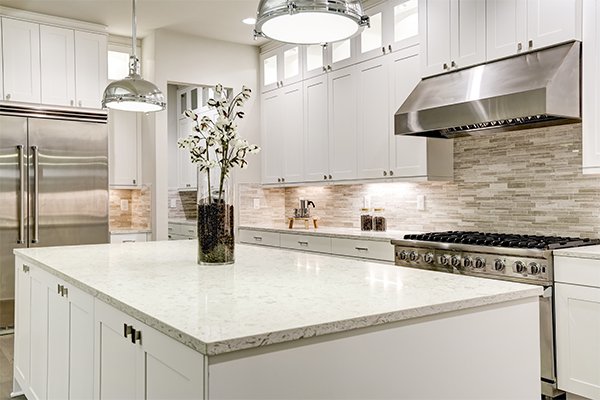
Granite Stone, Shale, and Engineered Surfaces: What’s Actually in Your Kitchen?
Granite geology and composition
Granite is a natural igneous rock formed when molten magma cools slowly deep beneath the Earth’s crust. This slow cooling gives granite its coarse, crystalline structure:
- Quartz – very hard, provides scratch resistance
- Feldspar – contributes most of the base color (white, cream, grey, pink)
- Mica and accessory minerals – create dark flecks, veins, and sparkle
These minerals define the key characteristics of granite:
- High hardness and durability
- Excellent heat resistance
- Slight porosity (why sealing granite matters)
- Naturally varied patterns that make every slab unique
Why shale doesn’t belong on your countertop
Shale, by contrast, is a sedimentary rock made from compacted clay and silt. It:
- Splits into thin, flaky layers
- Weathers and crumbles easily
- Lacks the structural strength for countertop use
So while shale appears in exam questions, it never appears as a countertop surface. In real kitchens and baths, you’re comparing granite vs quartz countertops, not shale vs granite.
Natural vs. engineered granite alternatives
Alongside granite, many homeowners consider engineered quartz:
- Made from ground quartz plus resins and pigments
- Non-porous and very stain-resistant
- Extremely consistent in color and pattern
Granite is 100% natural stone; quartz is engineered. Both are strong enough for kitchens, but only granite can be refinished, re-polished, and often repaired in place when cracks or chips appear.

Why Granite Countertops Crack in the First Place
Even though granite is strong, it isn’t invincible. Common causes of cracks include:
- Insufficient support
- Large overhangs without brackets
- Weak areas around dishwashers or cutouts
- Improper installation
- Cabinets not level
- Inadequate substrate or shimming
- Structural movement
- House settling
- Shifts in cabinetry or subfloor
- Impact or thermal shock
- Heavy pots dropped on thin sections (sink rails, cooktop cutouts)
- Extreme, localized temperature changes
Understanding why your granite cracked helps you decide whether repair, reinforcement, or partial replacement is the right move—and helps prevent future damage.
Types of Cracks in Granite Stone
Not all cracks are equal. Identifying the type of crack in your granite stone will guide your repair strategy.
Hairline surface cracks
- Very thin; may barely catch a fingernail
- Often limited to the surface polish
- Common around cutouts and corners
These are usually cosmetic and can often be repaired with stone-safe resins and polishing granite surfaces.
Natural fissures vs true cracks
Many granites have natural fissures:
- Tiny, vein-like lines formed during the stone’s geological history
- Typically smooth to the touch
- Not structurally problematic
Fissures are part of the stone’s natural beauty and usually don’t need repair. Cracks, however, show separation, roughness, or movement between sides.
Structural cracks
- Wider and clearly visible
- May show a height difference (“lippage”) between sides
- Sometimes move when you press down near the crack
Structural cracks typically result from stress, poor support, or significant impact. These often require professional evaluation and, in some cases, reinforcement or partial replacement.
Should You Repair, Reinforce, or Replace Cracked Granite?
Before jumping into how to fix a crack in a granite countertop, consider:
- Location:
- Hairline crack in a low-visibility spot: often suitable for DIY repair.
- Long crack spanning a sink rail or seam: likely needs a professional.
- Movement:
- No movement, tiny gap: resin repair and refinishing can work.
- Visible movement or sagging: suggests structural issues that need reinforcement or replacement.
- Granite countertop cost vs repair cost:
- Small repairs cost far less than a full replacement.
- If the stone is dated and you were planning a remodel anyway, new countertops might be worth considering.
If the crack is severe or in a critical area, a stone fabricator may suggest reinforcement and a full refinish, rather than immediate replacement. For chips and edge damage, see:
How to repair chipped granite and How to Fix a Chip in Granite?
Step-by-Step: How to Fix a Crack in a Granite Countertop
Important: The steps below are best for hairline or minor non-structural cracks. For wide cracks, height differences, or movement, consult a professional stone repair specialist.
1. Clean granite countertops thoroughly
Adhesives and resins won’t bond to greasy or dirty stone.
- Wipe the cracked area with warm water and mild dish soap or a stone-safe cleaner.
- Use a soft cloth to remove grease, residue, and debris from the crack.
- Rinse with clean water and dry completely.
- Wipe the crack gently with isopropyl alcohol to remove remaining oils, then allow it to air dry.
This deep cleaning is the same foundation you need for everyday clean granite countertops—and for any successful repair.
2. Inspect the crack closely
Now determine what you’re dealing with:
- Run your fingernail across the crack—does it catch slightly or at all?
- Press gently on both sides—do you feel or see movement?
- Look along the surface line to spot any height differences.
If there’s no movement and the crack is hairline, DIY repair is more realistic. Any flex, sagging, or significant gap points to structural problems that need professional help.
3. Protect the surrounding granite stone
You want to keep resin where it belongs—inside the crack, not smeared across your finish.
- Apply painter’s tape along both sides of the crack, leaving only the crack exposed.
- Follow edges and corners carefully, especially on any decorative profiles.
This protects the existing shine of your white granite countertop or black granite countertops and makes cleanup easier.
4. Choose and mix your granite crack repair resin
Most crack repairs use a clear or tinted epoxy/acrylic resin designed for stone:
- Look for a product formulated for granite or natural stone.
- For lighter granite, you may want a tint kit to match the background color.
- For darker stones, a clear or dark-tinted resin may blend best.
Mix the resin and hardener exactly as instructed so it cures correctly and bonds with your granite stone.
5. Fill the crack
Now it’s time to actually fix the crack in your granite countertop:
- Use a small plastic spatula, toothpick, or fine applicator to push resin into the crack.
- Work along the full length so there are no air pockets.
- Slightly overfill the crack to account for minor shrinkage and leveling later.
- Wipe away any obvious excess on top of the tape while the resin is still workable.
Let the resin cure undisturbed for the time recommended by the manufacturer—often several hours or overnight.
6. Level and polish granite surfaces
After the resin has fully cured:
- Carefully remove the painter’s tape.
- If the repaired area is slightly raised, use a razor blade held almost flat to gently shave down excess resin (only if your kit recommends this method).
- Use a stone-safe polishing compound or pad to blend the repaired zone with the surrounding finish.
This is where polishing granite surfaces really transforms the repair from “patched” to “barely noticeable.”
If the whole top looks dull or scratched, consider a full refinish rather than spot-polishing. That’s where the broader question Can Granite Countertops Be Refinished? comes into play.
7. Seal granite after repair
Once the repair is smooth and clean, protect your investment:
- Apply a quality penetrating granite sealer over the repaired area—or the entire top.
- Allow it to dwell per instructions so it penetrates pores around the crack.
- Wipe off any excess and buff with a soft cloth.
Regular sealing granite:
- Helps prevent stains from soaking in
- Makes removing stains from granite easier when spills happen
- Supports the longevity of both the stone and the repaired area
When to Call a Professional for Cracked Granite
DIY isn’t always the best answer. You should call a stone pro if:
- The crack is wide, long, or clearly structural
- There’s movement when you press around the crack
- The crack crosses a seam or runs along a thin sink rail
- Cabinets below show signs of movement or sagging
A professional can:
- Reinforce the underside with steel rods or mesh
- Inject high-performance resins under pressure
- Re-level seams and correct support issues
- Fully refinish and re-polish the surface
For more severe damage or full-top restoration, refer to resources like How to fix cracked granite.
Granite vs Quartz Countertops and Other Materials After a Crack
A crack often makes homeowners question their original material choice. It helps to see where granite stands in broader comparisons.
Granite vs quartz countertops
- Granite
- 100% natural stone
- Excellent heat resistance
- Repairable, re-polishable, and refinishable
- Quartz
- Engineered stone
- Non-porous, no sealing required
- More vulnerable to high heat because of resins
Both can crack under extreme stress, but granite’s ability to be restored gives it strong long-term value, especially when combined with affordable granite countertop options from common color ranges.
Granite vs marble: pros and cons
- Marble is softer, more porous, and prone to etching and scratches.
- Granite is harder, more scratch-resistant, and more suitable for busy kitchens.
Granite vs soapstone durability
- Soapstone is non-porous but quite soft and easy to dent or scratch.
- Granite offers better scratch resistance and longer-lasting polish.
Granite better than concrete countertops
- Concrete can crack, stain, and requires significant sealing and reinforcement.
- Granite is naturally dense, strong, and easier to maintain.
All of this makes granite a strong choice in any natural stone countertop comparison, even after a crack repair.
Cost, Style & Aardwolf Granite: Planning Beyond the Crack
If your cracked granite is repairable, you can often extend its life for many years. But if you’re planning a remodel or replacement, cost and design come into play.
Granite countertop cost and sourcing
Your final granite countertop cost depends on:
- Stone rarity and pattern
- Thickness and edge profile
- Layout complexity and cutouts
- Source: local fabricators, big-box stores, or wholesale granite suppliers
This is where a curated offering like the Aardwolf granite countertop collection helps streamline choices.
Aardwolf granite solutions
With Aardwolf, you can move beyond a simple repair into a more strategic upgrade:
- Aardwolf premium granite slabs are selected for structural integrity and visual appeal.
- The range includes many of the best Aardwolf granite colors, from subtle neutrals to bold, high-contrast patterns.
- Aardwolf granite installation services provide professional templating, support planning, seam placement, and finishing—reducing the risk of future cracks.
- The Aardwolf granite pricing guide helps you understand how stone choice, layout, and edges affect budget, making it easier to compare options against quartz or other materials.
Final Takeaway: How to Fix a Crack in a Granite Countertop the Smart Way
Cracks in granite are alarming, but they don’t always mean you need to rip everything out.
To recap how to fix a crack in a granite countertop:
- Identify whether the crack is hairline/cosmetic or structural.
- Deep clean the area to ensure strong resin bonding.
- Mask surrounding stone to protect your finish.
- Fill the crack with a granite-safe resin or epoxy, slightly overfilling.
- Let it cure fully, then level and polish granite surfaces to blend the repair.
- Reseal the stone to protect against future staining.
- Call a professional for wide cracks, movement, or underlying structural issues.