
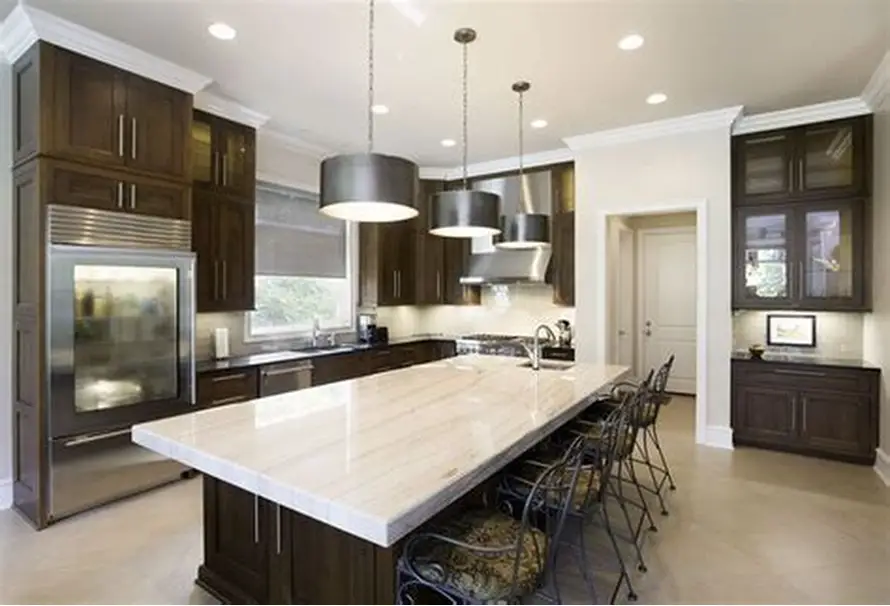
Seeing a small chip in your granite countertop right on the edge of the sink or island can be heartbreaking. Granite is marketed as nearly indestructible, so that tiny missing corner can feel like a huge flaw.
The good news:
For many small chips, you can repair granite yourself using simple superglue (cyanoacrylate) and a little patience.
And what about shale in all this? Shale is a soft, layered sedimentary rock that gets mentioned in geology class—but it has no place in kitchens. It would crumble under daily use. In real homes, the conversation is about granite stone, quartz, and quartzite, not shale countertops.
In this guide, you’ll learn step-by-step how to repair chipped granite with superglue, when this DIY method is appropriate, and when to call a pro. We’ll also look at how chip repair fits into granite’s overall cost, durability, and design advantages.
For deeper reading later, you might also explore:
- Can Granite Countertops Be Refinished?
- How to repair chipped granite
- How to Fix a Chip in Granite?
- How to fix cracked granite
Understanding granite stone (and why shale doesn’t belong in the kitchen)
Granite geology and composition
Granite is a natural igneous rock formed when molten magma cools slowly deep beneath the Earth’s crust. That slow cooling allows big mineral crystals to grow, primarily:
- Quartz – extremely hard and scratch-resistant
- Feldspar – makes up most of the background color (white, cream, grey, pink)
- Mica and accessory minerals – create flecks, veining, and sparkle
These ingredients give the core characteristics of granite:
- High hardness and durability
- Excellent heat resistance
- Slight porosity (so sealing granite is important)
- Unique patterns—no two slabs look exactly alike
That’s why properly installed and maintained clean granite countertops can last decades.
Why shale isn’t a countertop material
Shale is a sedimentary rock made from compacted clay and silt. It:
- Splits into thin layers
- Weathers and crumbles relatively easily
- Lacks the structural strength for counters
So shale appears on geology diagrams, but you’ll never see it in a showroom. In any serious natural stone countertop comparison, shale simply isn’t an option—granite, quartzite, marble, soapstone, and engineered quartz are.

Why granite chips (even though it’s so strong)
Even with all its strength, granite stone can chip—especially on exposed edges and corners.
Common causes include:
- Impact
- Heavy pots, pans, or tools hitting the edge
- Bottles or appliances bumped against corners
- Thin or unsupported edges
- Overhangs without proper brackets
- Narrow strips around sinks and cooktops
- Existing micro-cracks or weak spots
- Natural fissures combined with impact
- Stress from installation or cabinet movement
The good news is that many of these chips are cosmetic, not structural, and can be fixed with superglue or professional resins.
When superglue repair is a good idea (and when it’s not)
Good candidates for superglue chip repair
Superglue is best for:
- Small chips on edges or corners
- Shallow surface pits that don’t go deep into the stone
- Chips where the missing material is roughly 1–5 mm
These are the cosmetic flaws that catch your eye and your sponge but don’t affect the structural integrity of the countertop.
When to avoid DIY superglue repair
Superglue is not ideal if:
- The chip is large or deep (more like a chunk missing than a chip)
- There are associated cracks radiating from the chipped area
- The damage is near a seam, sink rail, or unsupported overhang
- The countertop is obviously moving or sagging
In those cases, a stone professional should evaluate the damage. You may need a more advanced repair, reinforcement, or (in rare cases) replacement. For more serious cases, see:
How to fix cracked granite.
Tools & materials to repair chipped granite with superglue
Here’s what you’ll typically need:
- Gel superglue (cyanoacrylate) – gel formula is easier to control on vertical edges
- Optional: superglue activator spray (to speed curing)
- Painter’s tape – to mask around the chip
- Razor blade or utility blade – for leveling the glue after it cures
- Fine sandpaper or diamond polishing pads – for blending and smoothing
- Microfiber cloths – for cleaning and buffing
- Stone-safe cleaner and isopropyl alcohol – for degreasing
- Granite sealer – to reseal the area after the repair
Safety extras are always smart: gloves, eye protection, and good ventilation.
Step-by-step: how to repair chipped granite with superglue
1. Clean and degrease the chipped area
Any repair begins with clean granite countertops:
- Wash the area around the chip with warm water and a few drops of mild dish soap or stone-safe cleaner.
- Rinse and dry thoroughly.
- Wipe the chip and surrounding area with isopropyl alcohol to remove oils and residue.
- Let everything air-dry completely.
Adhesives don’t bond well to greasy or wet stone, so don’t rush this part.
2. Mask around the chip with painter’s tape
To protect the rest of your granite stone finish:
- Apply painter’s tape around the chip, leaving only the damaged spot exposed.
- Follow the edge profile carefully (especially on beveled or rounded edges).
This keeps superglue from smearing across your polished surface and makes cleanup easier later.
3. Apply gel superglue to the chip
Now you’ll fill the chip:
- Hold the superglue nozzle just above the chip.
- Slowly squeeze a small amount into the void, letting it settle and self-level.
- Slightly overfill the chip so the glue stands a bit proud of the surrounding surface—this gives you material to shave down later.
If you have activator spray, you can lightly mist it according to instructions to speed curing. Otherwise, allow the glue to cure fully (often several hours or overnight).
Tip: On very dark or very light stones (like a deep black granite countertop or a bright white granite countertop), choose a clear or tinted glue that blends with the stone as much as possible.
4. Level the repair with a razor blade
Once the superglue is fully cured:
- Carefully peel off the painter’s tape.
- Hold a razor blade almost flat against the granite, with the blade angled very slightly so you’re skimming the glue, not gouging the stone.
- Gently scrape across the repaired area to shave off any excess glue.
Work slowly and patiently. The goal is to bring the glue level flush with the surrounding granite, so it feels smooth to the touch.
5. Lightly sand and polish the repaired area
To blend the repair:
- If needed, use very fine sandpaper or diamond polishing pads to smooth any micro-high spots.
- Follow with a stone-safe polishing compound to restore shine and gloss.
- Buff with a microfiber cloth until the repaired area matches the surrounding finish as closely as possible.
This is where a professional has an advantage—fabricators use graded diamond pads and polishing systems—but with care, you can get a surprisingly good DIY result.
For more detailed guidance on cosmetic repairs and alternatives to superglue, see:
How to repair chipped granite and How to Fix a Chip in Granite?
6. Reseal the granite after the chip repair
Once you’re happy with the look and feel:
- Clean the area again with a stone-safe cleaner and allow it to dry.
- Apply a granite sealer across the repaired area (or the entire countertop for best protection).
- Let the sealer dwell, then wipe off any excess and buff dry.
Regular sealing granite helps prevent staining and makes removing stains from granite much easier in the future.
How chip repair fits into granite vs other countertop materials
When you learn how to repair chips yourself, you begin to see how flexible and forgiving granite really is compared to some alternatives.
Granite vs quartz countertops
- Granite
- 100% natural stone
- Excellent heat resistance
- Can be repaired, polished, and even refinished in many cases
- Engineered quartz
- Non-porous, no sealing required
- Highly stain-resistant
- More sensitive to high heat; some damage is harder to repair invisibly
Being able to repair chips yourself (or have a pro do it) is one reason many homeowners still choose granite in the granite vs quartz countertops debate—especially when they learn that sometimes granite is cheaper than quartz in their market.
Granite vs marble: pros and cons
Compared to marble:
- Granite is harder, more scratch-resistant, and far more resistant to etching.
- Chips and minor flaws in granite are generally easier to live with and repair.
In everyday kitchens, granite usually wins the granite vs marble: pros and cons matchup on practicality.
Granite vs soapstone durability
- Soapstone is non-porous and stain-proof, but soft and easy to scratch or dent.
- Granite offers better scratch resistance and retains its polish longer.
Granite better than concrete countertops
- Concrete countertops can crack, stain, and require heavy reinforcement and frequent resealing.
- Granite is naturally dense, strong, and relatively straightforward to maintain and repair, which is why many people conclude that granite is better than concrete countertops for long-term reliability.
Cost, value & Aardwolf granite: thinking beyond one chip
A single chip is annoying, but it’s also a reminder to think about granite countertop cost, value, and future plans.
If your countertop is otherwise in great shape, a simple superglue repair is often all you need. But if the surface is dull, scratched, or filled with many small chips, it might be time to think bigger:
- Full resurfacing or refinishing (see: Can Granite Countertops Be Refinished?)
- Upgrading to new stone in a different color or pattern
- Coordinating stone with new cabinets, backsplashes, or flooring
The Aardwolf granite countertop collection can help if you do go the upgrade route, offering:
- Carefully selected Aardwolf premium granite slabs
- A wide palette of the best Aardwolf granite colors for every style—from modern minimalism to classic kitchens
With Aardwolf granite installation services, you also get:
- Professional templating and support design (to reduce the risk of future chips and cracks)
- Expert seam placement and edge finishing
- Proper first-time sealing and care instructions
And the Aardwolf granite pricing guide helps you compare:
- Affordable granite countertop options vs more exotic stones
- Different thicknesses, edges, and layouts
- Granite vs other materials for your budget
Final thoughts: should you repair chipped granite with superglue?
For many small chips on edges and corners, yes—superglue can be a quick, effective, and inexpensive fix.
To recap how to repair chipped granite with superglue:
- Clean and degrease the chipped area thoroughly.
- Mask around the chip to protect surrounding stone.
- Fill the chip with gel superglue, slightly overfilling.
- Let it cure fully (or use an activator).
- Level the glue carefully with a razor blade.
- Lightly sand and polish granite surfaces to blend the repair.
- Reseal the area to restore protection.
For larger damage, widespread wear, or structural issues, a professional repair—or even a refinish or replacement—may be the smarter move. That’s when resources like:
- Can Granite Countertops Be Refinished?
- How to repair chipped granite
- How to Fix a Chip in Granite?
- How to fix cracked granite