

You picked granite because it’s beautiful and tough… so those cloudy rings and dull spots around the sink feel extra annoying. The good news is that most water stains on granite stone can be removed at home with simple, granite-safe methods. No harsh chemicals, no expensive rescue products.
In this guide, you’ll learn:
- What those “water stains” on granite really are
- The characteristics of granite that make stains possible
- Step-by-step methods to remove light water rings, hard water buildup, and darker moisture marks
- What not to use on granite
- How to prevent future stains and protect your investment
- How this ties into granite vs quartz countertops, cost, design, and Aardwolf granite options

Why Does Granite Get Water Stains?
A quick look at granite geology and composition
Granite stone is a natural igneous rock formed when molten magma cools slowly deep inside the Earth. That slow cooling creates visible crystals of:
- Quartz – super hard, adds scratch resistance
- Feldspar – gives the base color (white, cream, pink, gray, etc.)
- Mica & other minerals – add sparkle, specks, and pattern
This granite geology and composition is why granite is:
- Very hard and durable
- Naturally heat resistant
- Slightly porous – there are microscopic pores and tiny pathways inside the stone
Those tiny pores are the reason water, minerals, and oils can sometimes leave marks on both white granite countertop and black granite countertops if the stone isn’t sealed well or spills are left to sit.
If you’re curious about the “science side,” granite is a heterogeneous mixture of minerals, not a pure substance:
- Is granite a heterogeneous mixture?
- Is granite a pure substance or mixture?
- What does granite mean?
- What do granite and basalt have in common?
But for cleaning, what matters most is that granite is strong but not completely waterproof without good sealing.
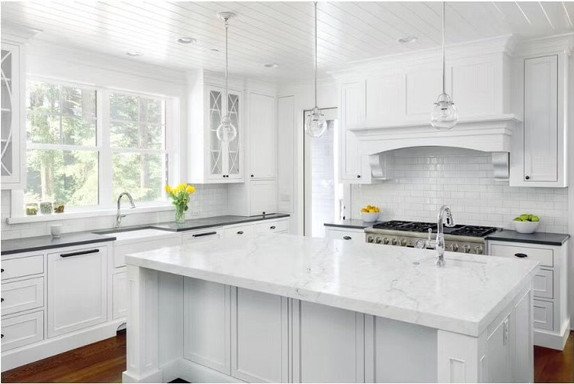
What Do “Water Stains” on Granite Look Like?
Not all water marks are the same. Before you grab the baking soda, figure out which one you have.
1. Light water rings and cloudy spots
- Faint, whitish rings where a glass or bottle sat
- Slight dull patch by the soap dispenser or faucet
- Usually minerals or soap residue dried on the surface
2. Hard water buildup
- Chalky white crust or scale around faucets and sinks
- Caused by hard water minerals (calcium, magnesium) left behind as water evaporates
3. Dark moisture stains
- Darker patch that lingers longer than surrounding stone
- Often right next to sinks, dish-drying areas, or under a wet mat
- Usually water absorbed into the stone or worn sealer
The method you use to remove water stains from granite depends on which of these you’re dealing with.
What You’ll Need (Granite-Safe Supplies)
Gather these simple supplies first:
- Soft microfiber cloths
- Mild dish soap (no lemon, no vinegar)
- Warm water
- Baking soda
- Plastic wrap and painter’s tape (for poultices)
- A granite-safe cleaner or hard water remover labeled safe for natural stone
- Optional for heavy scale on polished granite only:
- Plastic scraper
- Single-edge razor blade used very flat and gently
Cleaners and tools to avoid
To protect your clean granite countertops, skip:
- Vinegar, lemon juice, or citrus-based cleaners
- Bleach and harsh disinfectants
- Abrasive powders or scouring creams
- Steel wool or scratchy scrub pads
- Generic bathroom limescale removers that don’t say “safe for stone”
These can strip sealer, dull the finish, and even damage the granite surface over time.
Step 1: Start With Simple Soap and Water
For very light water rings or haze, this may be all you need.
- Mix a gentle solution
- Add a small squirt of mild dish soap to a bowl of warm water.
- Wipe the stained area
- Dip a microfiber cloth, wring it out, and gently wipe the spot in circles.
- Rinse
- Rinse the cloth in clean water and wipe again to remove any soap film.
- Dry thoroughly
- Buff dry with a clean, dry microfiber cloth so no water is left to sit.
Check the area in good light. If the ring or film is gone, you’re done. If you still see a faint halo, move on to baking soda.
Step 2: Use a Baking Soda Paste for Light Water Rings
Baking soda is slightly abrasive and absorbent, making it perfect for lifting surface mineral residue without scratching granite stone when used gently.
- Make the paste
- Mix baking soda with a small amount of water to form a thick paste—about the texture of toothpaste.
- Apply to the stain
- Spread a thin layer over the water mark or cloudy area.
- Don’t scrub hard—just coat the stain.
- Let it sit
- For newer stains, 1–2 hours is often enough.
- For older or more stubborn spots, cover with plastic wrap, tape down the edges, and leave overnight.
- Remove the paste
- Wipe off with a damp microfiber cloth.
- Rinse with clean water and dry thoroughly.
This is often enough to restore white granite countertops and darker stones that have slight water shadows.
Step 3: Treat Hard Water Buildup Around Faucets
If you’re dealing with crusty white buildup rather than faint rings, you’ll need to tackle hard water deposits.
A. Soften and gently scrape
- Soften the mineral crust
- Soak a cloth in warm, soapy water.
- Wrap or lay it over the crusted area for 10–15 minutes.
- Gently lift deposits
- Use a plastic scraper to carefully nudge the softened buildup away.
- On polished granite only, you can use a razor blade held almost flat to slide under deposits—never gouge or dig.
- Clean and dry
- Wipe with a damp cloth to remove residue.
- Dry completely with a microfiber cloth.
B. Use a granite-safe hard water cleaner
If haze remains:
- Spray a stone-safe cleaner
- Choose a product specifically labeled as safe for granite or natural stone.
- Spray or apply according to the instructions.
- Lightly scrub
- Use a soft cloth or soft-bristle brush to work on the deposit.
- Rinse and dry
- Wipe with clean water.
- Dry the area well to prevent new spots from forming.
Step 4: Use a Poultice for Dark Water Stains
Dark water stains are usually deeper—the stone soaked up moisture or the sealer failed in that spot. A baking soda poultice helps pull the moisture and minerals back out.
- Mix a thick poultice
- Combine baking soda and water into a thick, spreadable paste.
- Apply to the stain
- Spread the paste over the darkened area about 3–5 mm thick.
- Cover and wait
- Cover with plastic wrap.
- Tape down the edges so it doesn’t dry too fast.
- Leave for 12–24 hours. The poultice acts like a sponge, drawing moisture and contaminants out of the stone.
- Remove, rinse, and dry
- Peel off the plastic and wipe away the dried paste.
- Rinse with clean water.
- Dry thoroughly with a soft cloth.
- Repeat if needed
- Deep or older stains might need a second round.
If the stain persists or the surface looks etched or dull, you may need a professional stone care company to polish granite surfaces and restore the finish.
When the “Water Stain” Is Actually Oil or Rust
Not every dark mark on granite is caused by water. Two common imposters:
- Oil stains – dark, greasy-looking spots near the stove, under oil bottles, or around prep areas
- Rust stains – orange or brown discoloration near metal cans, tools, or sink hardware
For these, water methods won’t be enough. Use more targeted guides:
- For oil stains, try:
- For rust stains, see:
Correctly identifying the type of stain is key to removing stains from granite without damaging your sealer or stone.
How to Prevent Future Water Stains on Granite
Once your countertops look good again, a few simple habits will keep them that way.
1. Seal your granite regularly
Because granite is slightly porous, sealing granite with a good penetrating sealer will:
- Reduce how quickly water and oils soak in
- Make wiping up spills easier
- Help protect both white granite countertops and dark stones from long-term staining
Most homeowners reseal every 1–2 years, depending on how heavily the kitchen is used and the type of stone.
2. Wipe and dry as you go
- Keep a microfiber cloth or towel near the sink.
- After doing dishes, quickly dry around the faucet and soap dispenser.
- Wipe up spills and puddles as soon as you notice them—especially on lighter stones.
3. Protect high-risk areas
- Use trays under dish soap, hand soap, and cleaning bottles.
- Place coasters or mats under flower vases, drink dispensers, and appliances that sweat or drip.
These small steps help keep clean granite countertops looking like new.
Granite in the Bigger Picture: Cost, Design & Comparisons
While you’re already focused on granite, you might also be thinking about upgrades or changes.
Granite countertop cost & where to buy
Granite countertop cost depends on:
- Stone rarity and color
- Slab thickness and size
- Edge details and cutouts (sinks, cooktops, etc.)
- Local fabrication and installation rates
For affordable granite countertop options, consider:
- Common, widely available colors
- Standard edge profiles
- Working with reputable wholesale granite suppliers through a fabricator
Collections like the Aardwolf granite countertop collection can help you:
- Compare styles and finishes
- Use an Aardwolf granite pricing guide to stay within budget
- Choose from Aardwolf premium granite slabs for standout islands or feature walls
- Schedule professional Aardwolf granite installation services so everything is measured, cut, and installed correctly
Granite vs other countertop materials
In a natural stone countertop comparison, granite often sits in the “best all-rounder” spot:
- Granite vs quartz countertops
- Granite: natural, one-of-a-kind slabs, great heat resistance, needs sealing.
- Quartz: engineered, very consistent, lower maintenance, less heat-tolerant.
- Granite vs marble: pros and cons
- Granite: harder and more resistant to scratching and etching; better for busy, messy kitchens.
- Marble: softer and more porous; gorgeous but more high-maintenance.
- Granite vs soapstone durability
- Granite: tougher and more scratch-resistant.
- Soapstone: softer, easier to dent and scratch, but naturally non-porous with a soft, matte look.
- Granite better than concrete countertops
- Granite: less prone to hairline cracks, easier sealing, usually less fussy over time.
- Concrete: highly customizable, but can crack and stain if not carefully maintained.
Choosing the best Aardwolf granite colors for your cabinets, flooring, and granite backsplash designs lets you combine practicality with style.
Final Thoughts: Water Stains Don’t Mean Your Granite Is Ruined
To recap how to remove water stains from granite:
- Start simple: mild dish soap + warm water + microfiber cloth.
- Step up to a baking soda paste for light rings and cloudy spots.
- Tackle hard water buildup with softening, careful scraping, and stone-safe cleaners.
- Use a baking soda poultice for darker, deeper moisture stains.
- Call in pros if the finish has dulled or etched beyond DIY repair.